Back when the original ‘Cloverfield’ film was released in 2008, I remember the response to the film being fairly divided. As a survival-horror kaiju flick, I knew from the get-go that it would be my cup of tea, but the “found footage/shaky handcam” format that the film chose as a visual storytelling mechanic had alienated more than a few of my peers from the hectic giant monster fun. The movie itself wasn’t particularly revolutionary: a respectable, well executed found-footage thriller with some mysterious elements, but not anything I expected to see rolling out on a Criterion Collection Release anytime soon. The brunt of the Cloverfield magic came not from the product, but the marketing. Cloverfield had launched with an immersive and expansive ARG, its own expanded universe to explain causal tidbits that had led to the events depicted in the film, and to help flesh out accessory characters and entities with back-stories of their own. More often than not these characters ended up on-screen in the actual film only for mere seconds, but it was the very fact of this brief placement signifying a tie-in to some bit of story, told using a fake blog site or newsreel, that added a sense of breadth and intrigue to the brand.
When we got a ‘sequel’ in 10 Cloverfield Lane, it came as a let down for many that the two movies only seemed related by name alone. It also didn’t help that the second film was, on its own, a very, very strong and compelling psychopath hostage drama that was only made significantly worse by its seemingly forced Clover-verse tie-ins. The third and latest installment in the not-quite series, “The Cloverfield Paradox”, appeared almost as instantaneously and without explanation as the monster did back in ‘08’. A super-bowl ad placement and some few hours of waiting later, what would’ve been a quiet night spent with my e-reader transformed entirely into a hype opening night screening right in my living room. I didn’t really care about the abrupt ‘straight-to-netflix’ nature of the release (which did seem odd, seeing as the previous two had gotten full theatrical runs), because hey, if I get to watch it sooner, I can’t really complain.
The Timeline:
A confusing and abrupt arrival suits ‘The Cloverfield Paradox’ just fine, as the film attempts to be some interesting mix of temporal prequel/sequel, following a story that would attempt to serve as a catalyst for the events in the other films. It’s messy, janky, and not at all concrete, but it’s certainly possible to draw the causal links from this film to the others, due mainly to the (suspiciously convenient) ‘multiverse’ plot element that’s explained briefly at the beginning of Paradox, and that becomes its main sci-fi conflict.
-
UNIVERSE A (Paradox): 2028 - In an attempt to stave off an energy crisis driving nations to war over oil and resources, The Shepard Reactor/Cloverfield Station is test-activated (Tagurato Corp. Logo seen on station suggests they own it)
-
A: Catalyst - The Shepard Reactor overloads due to a Higgs-Boson particle triggered malfunction, creating an interdimensional rift that causes A to clash with 2 or more multiverse dimensions, triggering events referred to by a scientist during a tv interview at the beginning of the film.
-
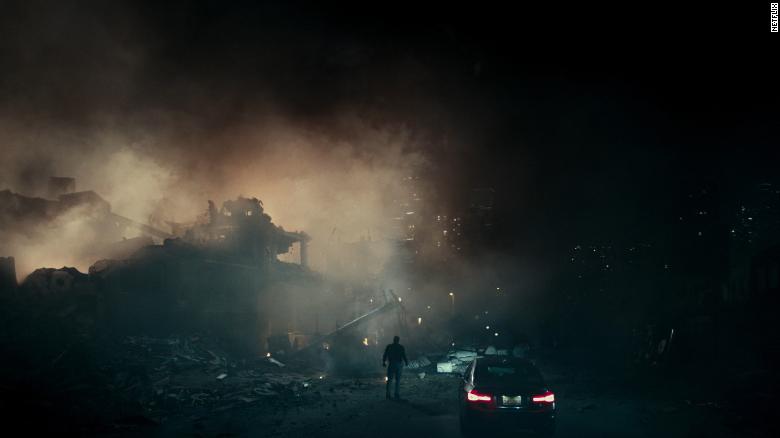
A: At least one Supergiant/mother “Clover” monster (seen breaking through the cloud barrier at the end of Paradox) and multiple, giant Clover monsters (the shadow of one is seen moving in the mist behind the ruined hospital, and is clearly smaller than the supergiant Clover) appear and start to destroy various cities in 2028
-
UNIVERSE B (Cloverfield 2008): Sometime pre-1998 - at least one (known) “child” clover monster is separated from the others who appear in A and appears deep underwater near the New York coast, along with a mysterious substance referred to as “Seabed’s Nectar”. The creature enters or is already in a state of suspended animation.
-
B: 1998-2005 - Tagurato Corp. builds the Chuai Station oil drilling rig mid-atlantic near Connecticut.
-
B: 2007 - The Monster is discovered by a Tagurato marine biologist who is assassinated by the company as a means to keep the the monster’s existence a secret. Chuai Station is a front to study the creature and harvest Seabed’s Nectar; There is no oil in the station. The nectar is processed into Tagurato’s “Slusho” brand drinks and sold publicly using unverified claims of massive health benefits to market the ingredient. Tagurato Corp. continues to keep knowedge of the Clover monster a secret.
-
B: Disturbed by Tagurato Corp. submarines, the Clover attacks and destroys Chuai Station.
-
B: 2008 - Tagurato launches their Hatsui imaging satellite to keep track of the monster. A strange object presumed to be a chunk of the Japanese satellite “ChimpanzIII” plunges into the Atlantic ocean (Seen at the end of Cloverfield 2008). About a month later, the monster surfaces and attacks New York City and the main events of Cloverfield ‘08 take place.
-
UNIVERSE C - (10 Cloverfield Lane): 2016 - The interdimensional rift created by the Shepard Reactor in A exposes this dimension to an alien invasion. Howard Stambler, a former employee of Tagurato’s tech subsidiary ‘Bold Futura’, finds out about the imminent invasion and the events of 10 Cloverfield Lane take place. The events in this dimension are more or less isolated insofar as further connection to the clover-verse as of the time of writing.
-
UNIVERSE A2 (Paradox): 2028 - The Shepard Reactor overload in A causes that universe’s Cloverfield Station to be transported into a parallel universe, where it merges with this universe’s Cloverfield station, generating a “Cloverfield Paradox” as both stations from the different dimensions are simultaneously trying to occupy the same space. In this dimension, Earth is embroiled in bitter international conflict, as the resource wars that were in their diplomatic infancy in A are already in full swing in A2.
-
A2: The crew of this Cloverfield Station haven’t yet been able to figure out how to achieve a stable Shepard Reactor ignition, and after the main events of ‘The Cloverfield Paradox’, crew member Hamilton imparts this knowledge to her A2 counterpart along with a warning via transmission, before returning to her own A. We leave The ‘War Dimension’, A2, in a state of war, but with the capacity for free, cheap unlimited energy. The effect this tech has on the global conflict in this dimension is as of yet unknown.
-
A: The return of the Cloverfield Station to its dimension of origin, and the successful, stable ignition of the Shepard Reactor, do not have the damage reducing effects as hoped for by the crew physicist, Schmidt, as it is revealed during reentry to Earth’s atmosphere that the planet, unbeknownst to the crew, is still under siege from massive clover monsters, implying that the supernatural phenomena/sci-fi conflicts that have been set in motion in countless other multiverse dimensions by the reactor overload are by no means resolved.